If you do a Google search for “showing up,” you get all sorts of links and suggestions as to what it means. Showing up for a performance, showing up for important events in your life for your friends and family, showing up at work by giving it your attention and energy.
Showing up is important. As Seth Godin put it, though, we’ve moved way beyond simply showing up, sitting in your seat and taking notes. Your job is to surprise and delight and change the agenda. Escalate, reset expectations and make your teammates delighted.
Show up to delight your visitors
Sure, showing up is important. On a personal and business level to me, showing up means controlling my behaviors and emotions. Knowing that when I set out to do a day’s work, I have a pretty good idea of what I need to do (calls, projects, communications with clients, writing, etc.), and doing my best to do it, every day. For example, I made a commitment in January of 2017 that I would show up every Monday to do a video blog/podcast for at least a year. Once the year was up, I would assess it from a number of angles. Was is working? Was it fun? Was it good? Did it get any attention? Did my guests get anything worthwhile out of it? Did the listeners give good feedback, even if there were very few? Based on my assessment of those questions (not all were completely positive, but enough were) I committed to another year. Then another.
So here we are.
Showing up at a tradeshow is more than just being there. If
you are to take Seth Godin’s perspective, you want to have more than just a
nice exhibit. You want to show up with more than just average enthusiasm and
average pitches to your visitors. You should set high expectations for your
company and your team.
How can you do that? By starting months before the show and
having ongoing conversations about how to get visitors to interact. How to get
them to respond. How to tell your company or product’s story. How to make it
exciting to just visit your booth, exciting enough so that your visitors feel
compelled to tell others to come.
There are no wrong answers, and plenty of right answers.
I’ve been attending tradeshows for nearly twenty years. In
looking back on photos from that era – the early ‘Naughts as the first ten years
of this century are sometimes referred to – things look different. It’s often
subtle, but what the photos from that era show is what’s NOT there. You have to
look closely and compare the images from around 2003 – 2005 with images from
today’s shows.
Lots of these types of exhibits in 2004 (Natural Products Expo West)
The big changes?
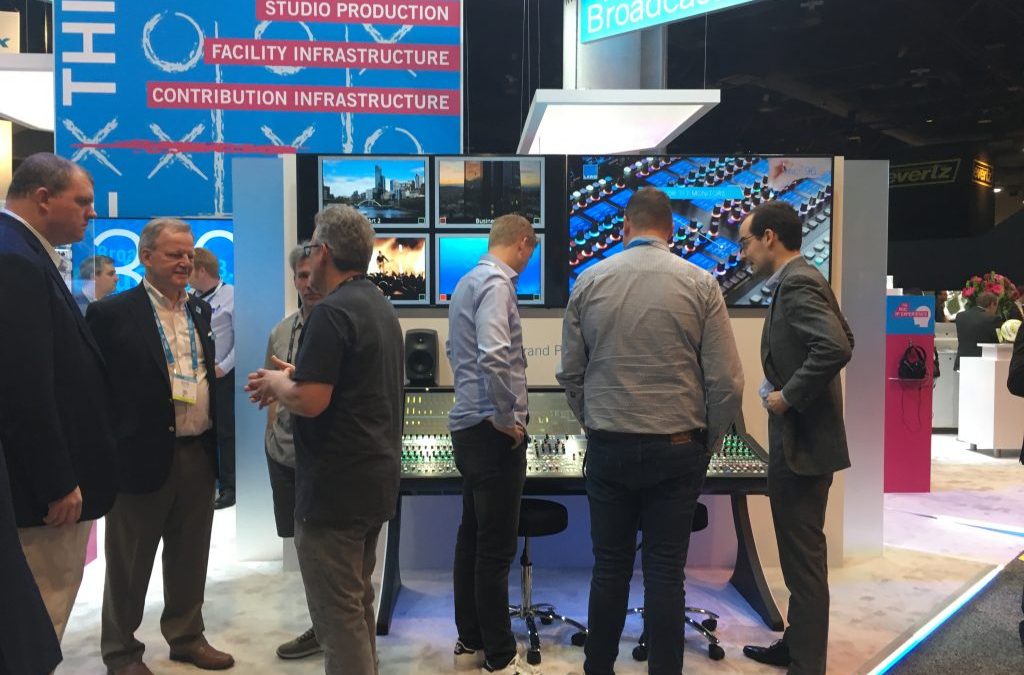
Video: Depending on the show, some are stark and blatantly obvious. For example, I saw so many large video walls at this year’s National Association of Broadcasters Show in Las Vegas I lost count. Big, small, portable banner-stand-like video walls, large walls used for training (Adobe and others), most of them extremely high quality.
Some smaller shows or different types of shows may not have
the large video walls (or only a few), but my impression is that a majority of exhibits
have large video monitors. These typically range from around 40” to as much as
70” and all show sharp images. It’s much easier to attach monitors on exhibit
walls when the monitors are so slim compared to what was available a couple of
decades ago.
Fabric Graphics: Printing on fabric has come so far, it’s hard to imagine what it was like at the turn of the century. Printers have gotten so much better and fabrics have also improved that in many cases what you’re seeing on the exhibit walls are fabric graphics printed with such depth and clarity it compares with top of the line paper printing.
LED lighting: Hand in hand with fabric graphics, the evolution of LED lighting has meant better lights for a fraction of the cost. Combine LED lights and an aluminum frame with fabric graphics and voila you have a fantastic-looking lightbox that shines!
Augmented Reality: I’ve only seen this a few times at tradeshows, but I think it’s going to spread. It’s showing up at museums and other permanent installations. Why not tradeshows?
3D Virtual tours: Again, not used so much these days, but check out the recent interview I did with Phil Gorski from Ova-Nee Productions and see what they’re doing in the tradeshow space. I can see this happening more and more to take the physical tradeshow to a larger audience in the digital world.
Virtual Reality: Not something that is taking over the tradeshow world, but it is definitely there and a smart exhibitor that chooses to use VR will plan to do it right. Here’s an interview I did with Foundry45‘s Dave Beck.
Interactive Touch Screens: Depending on the way you want your visitors to interact this can be a big benefit to help show off your company, products and people.
Charging Stations: At the turn of the century hardly anyone thought of the need to charge a portable device. Now it’s hard to find anyone who doesn’t have that need a time or two a day during a long tradeshow. Charging stations can be custom-designed and built to fit your brand and to fit seamlessly into your exhibit.
Apps: Of course, there were no apps 15 – 20 years ago. Today it is a rare tradeshow that doesn’t have its own app where you can find exhibitors, information and subscribe to updates about the show.
Big Video Walls in 2019 (NAB Show 2019)
Social Media: This also didn’t exist back then. Today it almost seems old school to be doing regular social media posting about your tradeshow appearance. I mean, even Grandma is on Instagram, right? But social media is still a good way to post photos, respond to comments and let your followers know what’s going on while your company is exhibiting.
Here’s a novel idea: using the 3D Virtual Tour technology that is often used on real estate to allow potential buyers to virtually steer their way through the home, and use that tech to allow people to visit your tradeshow booth long after the show has ended.
That’s the topic of today’s interview on the TradeshowGuy Monday Morning Coffee. Phil Gorski of Ova-Nee Productions spent a little time sharing how he started the company and how the technology works on a tradeshow booth.
At tradeshows, the game is all about attracting attention.
Have you considered a custom-printed floor?
Every client we’ve worked with that has chosen to use a
custom graphic on a printed floor has been happy with the result. They like it,
it looks good with the rest of the booth, and it gets positive comments from
their visitors.
There are a lot of different floor choices, but what I’m
talking about here is bringing the area below your feet into the overall graphic
design of the exhibit and booth area. When you incorporate a branding element
into the floor as part of the overall look, it adds POP and depth. Take a look
at these examples:
With Schmidt’s Naturals, their iconic flowery design spreads across the 10×40 space. It reinforces their overall brand. And when added to the clean and spare look of the rest of the exhibit elements, the colorful floor stands out.
Schmidt’s Naturals and their custom colorful flooring
Wildbrine chose a custom-printed floor that also added to the overall color scheme. The striped green and black floor added another dimension to the bright colors throughout the rest of their simple layout.
Wildbrine’s custom flooring of green and black stripes
Of course, you can create a custom look without printing a graphic below your feet. Another way is to use typical flooring but present it in unusual cuts or angles:
Dave’s Killer Bread/Alpine Valley’s custom-cut floor shows separation between two brands.
Another great example of a custom cut
Colorful tiles stand out!
Bring on the deck and a fake pool at Birch Benders
Whatever flooring you choose, there are any number of ways to make it stand out.
Disclosure: Dave’s Killer Bread, Schmidt’s Naturals and Wildbrine are clients of TradeshowGuy Exhibits; the others shown here are not.
The marketing funnel. It’s something I learned about years ago, but it’s interesting to reexamine now and then. Recently I attended the NAB Show in Las Vegas as a blogger and was asked by a few dozen companies if they could scan my badge. Once they scanned, I was put in the top of their tradeshow marketing funnel, even though they did exactly zero qualifying. See where this is leading?
When it comes to tradeshow marketing, the funnel does indeed
get interesting. As in any type of marketing, there are things you can control
and things you cannot. Scanning the badge of every person that comes through
your booth does indeed capture name and contact information and will likely
mean they’ll soon be getting emails from your company.
Let’s look at the tradeshow marketing funnel starting at the
very top.
The first step – the top of the funnel where its widest – is
the number of people attending a particular tradeshow that you’re setting up an
exhibit. For the sake of argument and easy math, let’s say it’s 100,000 people.
Do the Math
If you are one of 2000 exhibitors, that means you’re vying
for the attention of those 100,000 people along with 1,999 other exhibitors.
If the show is three days, 10 am – 5 pm, that means the show
floor is open for 21 hours. If each attendee walks the floor an average of four
hours a day and manages to visit one booth every five minutes, that means they
are visiting (again this is hypothetical and on average) 12 an hour, or 48 a
day, or 144 over the course of the show. If every attendee visited each
exhibitor at the same rate, you’d get about 13.9% of the 100,000 attendees to
stop by your booth, or 13,900 people. That’s 660 per hour, or about 11 per
minute. If a visitor stops by a booth every 2 ½ minutes, these numbers double.
But since people are unpredictable, let’s stay with the five-minute visit on
average.
Now – if those numbers are even close to real, what are you
doing to get their attention?
Are you giving out samples to visitors, doing product demos,
having one-on-one conversations? Or are you just randomly scanning badges of
every visitor even though they haven’t expressed any interest in your products
other than standing within scanning distance of the booth.
Every one of those interactions will mean that each person
will go into the top of the funnel, although admittedly they can’t be treated
equally because some will be more interested than others, some will be more
prepared to buy than others, and some are just kicking tires.
But they’re all in the marketing funnel. At this point we
can treat them equally.
For argument’s sake, let’s say that for every ten that visit
your booth, one expresses interest, enough interest to let them capture their
contact information.
That means some 66 people per hour have made at least an
initial commitment to let you invite them to the next step of the funnel. They
may have opted into an email list, agreed to have their badge scanned, or had a
conversation with someone in the booth. Again, assuming the show is open for 21
hours, you have approximately 1386 at the second level of your funnel.
Move People Through the Funnel
What do you do to move them along?
Here’s where the marketing funnel gets more interesting. Do
you simply email them? Or do you call them one-on-one to assess their real need
(or lack) to find out if they are a “hot” lead, “warm” lead or just a “cool”
lead that will be put on the back burner and perhaps inserted into a drip
campaign? Do you send them a sample? A PDF report of some sort?
An ideal tradeshow marketing campaign will have a number of
options available at the show, and each interaction should assess the visitor’s
desires and situation.
And let’s add one more step to the math.
Let’s say the average profit of your product is $10,000.
By adding up all the costs of your tradeshow appearance, you’re
spending $100,000 for this particulate show. That means you need to sell 10
customers to break even. If your average profit is $1,000, you’ll need 100
customers.
Anything more than those numbers, and the Return on
Investment on your tradeshow marketing plan is out of the red and into the
black.
But let’s take it one more step.
Improving Funnel Results
Let’s say that for every customer that purchases your premium product continues to purchase other products from you for an average of 7 years. The lifetime value of that customer acquisition just increased substantially, which means the money you spent at the tradeshow to come into contact with her means a lot more.
And if they’re a really happy customer, they may end up referring
a handful of new clients to you. Which makes that initial cost look better and
better with each passing year.
The more tradeshows you exhibit at, the more people you put
your products and services in front of. If you’re doing things right, or at
least learning from any mistakes you’ve made over the years and made adjustments,
your tradeshow marketing funnel will become less leaky. You’ll retain more of
the people that enter at the top.
We all have leaky marketing funnels. But by being aware of what works, what doesn’t and doing your best to maximize your returns, your results will keep improving. But it means paying close attention at every step. Keep asking your prospects what they need to learn, do they want to hear more, do they want a free sample or another product demo, or how they may want to interact with you and your company.
Once the tradeshow is over, it’s only natural to want to skedaddle
the premises and hightail it home as fast as possible.
But WAIT. Before you go, if you’re in charge of the exhibit
properties, or at least delegating the jobs to various entities, go over your
checklist.
That checklist may look something like this:
Dismantle: Whether you’re hiring a professional I&D crew or taking down the booth with a few fellow employees, make sure to check that all parts and pieces make it into the shipping containers. I can tell you from personal experience that things go missing: carpet pieces, crate endcaps, products and much more. If you are there, take photos as things are put in the crates. If you’re not there, have your hired crew take photos. Most will do so without being asking just for their own records, but by asking you’re making sure that it happens (usually). It also doesn’t hurt to make a shortlist of what is in each crate. I have lost track of the number of times a client has asked if we can track down some particular item a few months after the show. Know what crate to look in makes it that much easier.
Shipping: If you’re using a shipping company, be in good contact with your contact about the details, such as the BOL (Bill of Lading), shipping address, number of crates and pallets, etc. At big shows, sometimes trucks will check in at 9 am but it’ll be hours until they are actually able to pick up your crates. You’ll be billed for the waiting time, of course. Communicate all pertinent information to your trucker: pickup address, check-in time, move-out times – anything that is available from the show organizers. It’s usually (but not always) on the website.
Leads collected: the most important thing, at least as far as management and the sales team are concerned. No matter what form you have them in, digital or analog, triple-check to make sure they are getting safely back to the office.
Reserve your booth space for next year. This may or may not be on your list. But if it’s something your team typically does ahead of time, make sure it’s done.
Congratulate yourself on a job well done. Plan a little thank you gathering (dinner, coffee and goodies?) back at the office for your team to show them how much you appreciate them.
Look ahead to next year. It’ll come quicker than you might think!
Last time when you set up your tradeshow exhibit and lived
in it for a few days, did it feel cramped? Were you wishing you had another table
to sit down at with potential clients? Trying to cram too many products on too
few shelves?
Maybe it’s time for a new exhibit. So what’s holding you back?
It might be finances. Certainly that’s one of the biggest things that holds any company back. But beyond money, are you moving out of your comfort zone? It happens frequently. Many clients we work with at TradeshowGuy Exhibits have been using banner stands and pop-ups, which transport easily and take just a few moments to set up. Nothing wrong with that, but these companies have grown enough that they can afford a larger exhibit, one that not only looks good to give their brand a brand new look, but because it’s more complicated it needs to ship in a wooden crate using semi-trucks, it will likely need to be set up by an I&D (installation/dismantle) management crew.
What will your visitors think when you show off a new exhibit?
And yes, that moves many companies beyond their comfort zone.
Having been down that road with a lot of companies, we often help navigate that
path.
But if it’s money, there are ways to convince the purse
holders that it’s time to invest in a new booth.
First, consider what would happen if you did nothing for the
next 2-3 years. Your exhibit would be a few years older. Many of your
competitors might already have upgraded to a new exhibit which will look a lot
sharper than yours. How will your visitors then perceive your company compared
to those competitors? Remember that perception counts a lot, and almost nowhere
does it count as much as it does at tradeshows. Visitors there see you at your
finest. And if your finest comes up short from what you want and what your
visitors think you should be, that could be a problem.
Then again, maybe a new exhibit isn’t the answer. You might
be better off investing in booth staff training. Or pre-show marketing. By doing
this, you can still crank up the ROI on your tradeshow marketing investment and
put off the exhibit investment for a couple more years.
But if you are seriously considering a new exhibit, think
about who it will impact and how. Where will you store it? How much will it cost
to ship or setup and dismantle?
Understand how much time you’ll need to design and fabricate
the exhibit by talking to experience exhibit builders. Your new exhibit will
last you several years, maybe 5 to 7 or more depending on the type of exhibit
and how you use it.
Once you’ve decided that it’s a good move to pitch the
powers-that-be, be prepared. Contact a few exhibit houses to understand their
processes and timelines required, along with budget ranges for the size and
type of exhibit you’re considering.
Make a written description of the exhibit requirements. When
pitching the boss, offer a reasonable price range for the project, how long it’ll
take to amortize the cost (3, 5, 7+ years), do your best to explain how the
next exhibit will increase your lead generation (three clients in the past
three years have told us that the increased size of the exhibit and the newness
of it tripled their leads at the first show!).
Show the “soft” return on the exhibit, such as the impact
the new look will have on your current customers who see the positive direction
your company is taking. Or on the employees, who see the same thing.
There are a lot of things that might be holding
you back from investing in a new exhibit. But with careful planning and working
with the right partners, you can create an environment and a situation where
the new exhibit can become a reality.
During a recent Tip Club networking group gathering, the topic turned to “hesitation” and how we often hesitate instead of moving forward. It got me to thinking about how we approach moments in life where we choose to hesitate. Why?
Also, a tradeshow tip of the week and this week’s ONE GOOD THING:
Good infographics communicate information in a way that no article alone can and these 100+ digital marketing stats are no exception. This new post from VisualCapitalist.com draws research from Hubspot, BrightEdge, Statista, FoundationInc, OptinMonster and many others to illustrate results that marketers get from email, social media, mobile, paid advertising, lead generation, content marketing and others. Yes, this is digital only, but so many tradeshow marketers are combining digital marketing with their face-to-face marketing, that it made sense to not only show a bit of the infographic, but link to it. Here’s a link to the blog post; here’s a link to the infographic itself. Or click the graphic below and go direct to the graphic which we’ve put on this blog.